
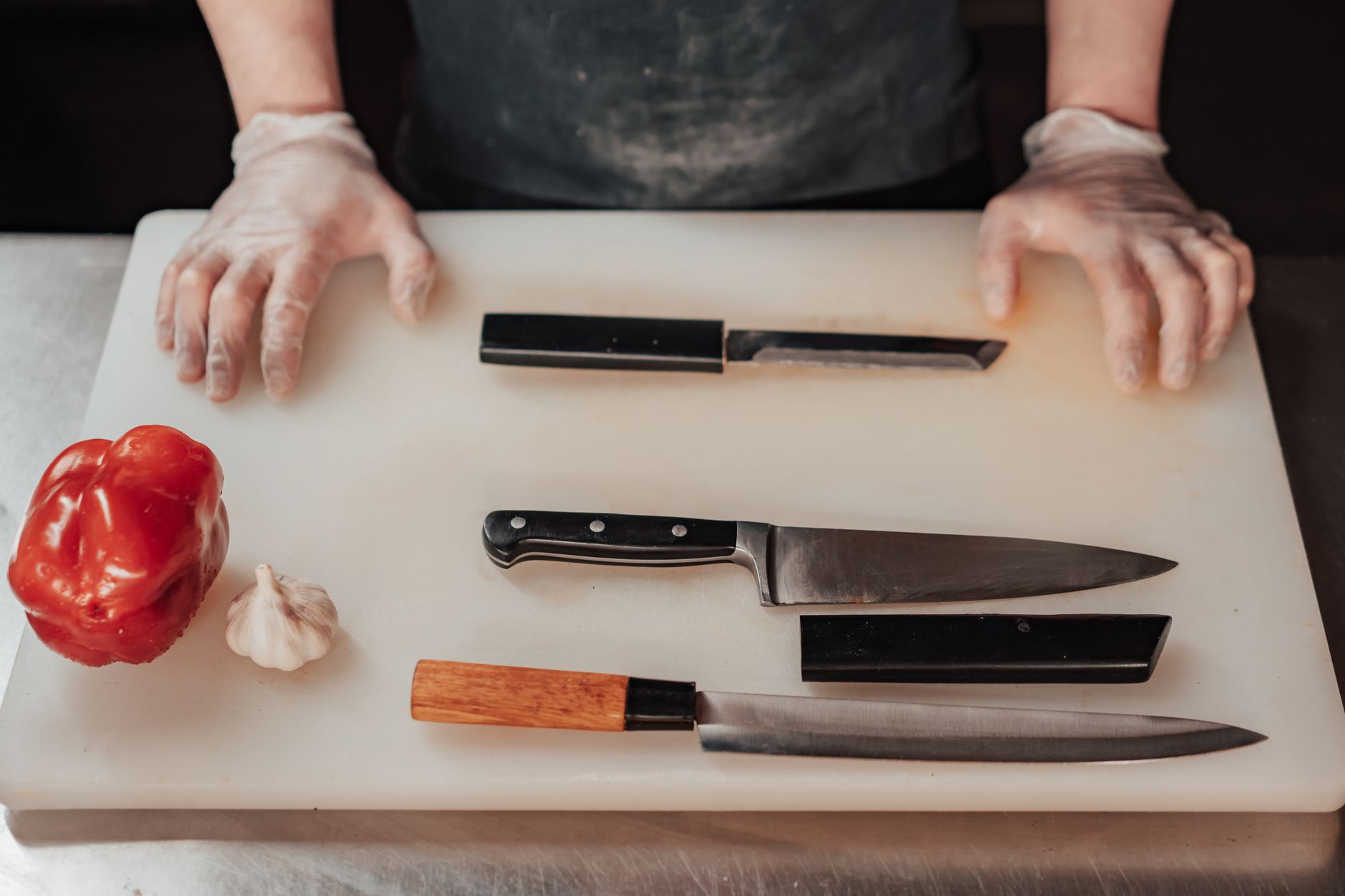

Santoku knives and nakiri knives both excel at vegetable prep, but they are not the same tool. Choose a santoku if you want an all-purpose Japanese blade with a slight belly, a useful tip, and the ability to handle meat, fish, and vegetables. Choose a nakiri if you want a flat-edged vegetable specialist for push cuts, straight-down chopping, and scooping produce. Both can live in the same kitchen, but the right first purchase depends on your cooking style.
Key Takeaways
- Santoku = generalist with a curved belly and tip; nakiri = rectangular vegetable specialist with a flat edge.
- Nakiri blades favor push cuts and straight-down chopping; santoku blades allow more rocking and slicing.
- Several supplied nakiri models use high-carbon stainless steel, hammered or hollow-edge patterns, and Pakkawood or rosewood handles.
- If you want both shapes in one kit, the MITSUMOTO SAKARI 4-Piece Japanese Chef Knife Set includes a Santoku and a Nakiri.
- Use the tables below to compare blade shapes, steel, handles, and manufacturer-highlighted features.
Table of Contents
Products Mentioned in This Guide
As an Amazon Associate, TheGearPool may earn from qualifying purchases.


Short Verdict
The santoku is the better one-knife generalist. The nakiri is the better dedicated vegetable tool. If you already own a chef’s knife or santoku, a nakiri is a useful second blade. If you are building a minimal kit, a santoku—or a set like the MITSUMOTO SAKARI 4-Piece Japanese Chef Knife Set that includes both shapes—may cover more ground.
Exact Models Compared
Affiliate disclosure: This article contains Amazon affiliate links. If you buy through those links, we may earn a commission at no extra cost to you.
The exact models below are the supplied product records used for this comparison. For a coordinated set that includes both a santoku and a nakiri, the MITSUMOTO SAKARI 4-Piece Japanese Chef Knife Set is the option that covers both blade shapes.
- imarku Nakiri Knife 7 Inch,Razor Sharp Japanese Kitchen knife Chef Knife
- HOSHANHO 7 Inch Nakiri Knife, Ultra Sharp Japanese Kitchen Chef Knife
- HOSHANHO 7" Nakiri Knife, Handcrafted Razor Sharp Meat Vegetable Cleaver
- PAUDIN Nakiri Knife – 7" Razor Sharp Meat Cleaver and Vegetable Kitchen Knife, High Carbon Stainless Steel, Multipurpose Asian Chef Knife for Home and Kitchen with Ergonomic Handle
- MITSUMOTO SAKARI 4-Piece Japanese Chef Knife Set, San-Mai 9Cr18MoV
| Exact model | Blade / steel | Handle | Manufacturer-highlighted features | Link |
|---|---|---|---|---|
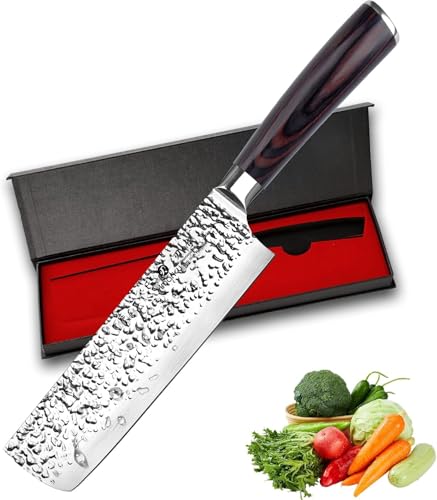
| imarku Nakiri Knife 7 Inch,Razor Sharp Japanese Kitchen knife Chef Knife | Japanese high-carbon stainless steel; 15° edge; hammered finish with hollow-edge design | FSC-certified deep brown Pakkawood; full-tang construction | Anti-stick design; mirror-polished spine; gift-ready packaging with protective sheath | Check price |
| HOSHANHO 7 Inch Nakiri Knife, Ultra Sharp Japanese Kitchen Chef Knife | 10Cr15CoMoV high carbon stainless steel; hardness up to 60HRC; 15° edge | Pakkawood handle | Scallop-shaped hollow pits; hand-polished blade; multi-function prep | Check price |
| HOSHANHO 7" Nakiri Knife, Handcrafted Razor Sharp Meat Vegetable Cleaver | 9-layer composite steel with 10Cr15CoMoV core; hardness 60±2; 2.5 mm double-bevel; 12–15° edge | Octagonal rosewood handle with copper wires | Stonewashed finish; black oxide; hammered texture; straight edge for chopping | Check price |
| PAUDIN Nakiri Knife – 7" Razor Sharp Meat Cleaver and Vegetable Kitchen Knife, High Carbon Stainless Steel, Multipurpose Asian Chef Knife for Home and Kitchen with Ergonomic Handle | 5Cr15MoV stainless steel; 56+ hardness | Pakkawood handle | Wave pattern for food release; all-purpose prep; easy to re-sharpen | Check price |
| MITSUMOTO SAKARI 4-Piece Japanese Chef Knife Set, San-Mai 9Cr18MoV | San-Mai 9Cr18MoV high carbon stainless steel; HRC 58±2; deep-cryo treated | Octagonal rosewood handles | Set includes Gyuto, Santoku, Nakiri, and paring knife; Tsuchime finish; sandalwood box | Check price |
Side-by-Side Comparison
| Factor | Santoku knife | Nakiri knife |
|---|---|---|
| Blade shape | Sheep’s-foot style tip with a subtle curve | Rectangular, flat-tipped, squared-off front |
| Edge profile | Slight belly; supports rocking and slicing | Mostly flat edge; built for push cuts |
| Tip utility | Pointed enough for precision and protein work | No pointed tip; wide front for scooping |
| Best motion | Rock, slice, chop | Straight-down chop, push cut |
| Common length range | Often 5–7 inches | Often 6–7 inches |
| Best for | All-purpose prep, meat, fish, vegetables | Vegetables, fruit, herbs, tofu, leafy greens |
Dimension-by-Dimension Tradeoffs
Blade shape and tip
The santoku has a distinctive sheep’s-foot profile: the spine drops to a rounded tip, but the tip is still more useful than a nakiri’s squared front. The nakiri is rectangular and blunt at the front, which makes it easier to scoop chopped ingredients and keeps the edge consistent for board-level cuts.
Edge profile and cutting motion
The santoku’s subtle belly allows a mild rocking motion. The nakiri’s flat edge is optimized for a straight-down push or chop. Manufacturer descriptions on the supplied nakiri models emphasize this: the HOSHANHO 7" Nakiri Knife, Handcrafted Razor Sharp Meat Vegetable Cleaver says the square shape and straight edge help when a chef knife’s rocking motion won’t do, such as chopping sweet potatoes or zucchini.
Height and scooping
Nakiri blades are often taller and flatter, which gives more space for the knuckles and works well for scooping from the cutting board. Santoku blades are generally lower-profile with a more tapered front, so they feel more nimble for slicing but less shovel-like.
Food release
Both styles may have textured blades. The supplied nakiri models show different approaches: imarku uses a hammered finish and hollow-edge design; HOSHANHO 7 Inch Nakiri Knife, Ultra Sharp Japanese Kitchen Chef Knife has scallop-shaped hollow pits; HOSHANHO 7" Nakiri Knife, Handcrafted Razor Sharp Meat Vegetable Cleaver uses a stonewashed finish and hammered texture; PAUDIN uses a wave pattern. These are manufacturer claims for reducing sticking and drag.
Steel and hardness
There is no single right steel, but the supplied nakiri models document their materials: imarku uses Japanese high-carbon stainless steel; HOSHANHO 7 Inch Nakiri Knife, Ultra Sharp Japanese Kitchen Chef Knife uses 10Cr15CoMoV high carbon stainless at about 60HRC; HOSHANHO 7" Nakiri Knife, Handcrafted Razor Sharp Meat Vegetable Cleaver uses a 9-layer composite with 10Cr15CoMoV core at 60±2; PAUDIN uses 5Cr15MoV stainless at 56+ hardness; the MITSUMOTO SAKARI set uses San-Mai 9Cr18MoV at about HRC 58±2. Higher hardness can support edge retention, but the manufacturer claims should be read in context.
Handle and balance
All supplied models use Pakkawood or rosewood handles, with full-tang or ergonomic balance claims. The imarku features a full-tang Pakkawood handle; the HOSHANHO 7" Nakiri Knife, Handcrafted Razor Sharp Meat Vegetable Cleaver has an octagonal rosewood handle with copper wires; the MITSUMOTO SAKARI set uses octagonal rosewood handles. These details affect grip feel and knuckle clearance more than the blade style itself.
Who Should Choose Each
Choose a santoku if…
- You want one general-purpose Japanese knife for daily prep.
- You regularly slice boneless meats, fish, or want a tip for detail work.
- You prefer at least a slight rocking motion.
- You want both blade types in one purchase: the MITSUMOTO SAKARI 4-Piece Japanese Chef Knife Set includes a Santoku and a Nakiri.
Choose a nakiri if…
- Vegetables, leafy greens, and plant-based prep dominate your cooking.
- You prefer push cuts and straight-down chopping over rocking.
- You like a flat, rectangular blade that scoops from the board.
- You already own a chef’s knife or santoku and want a dedicated vegetable blade.
Among the exact nakiri models listed: the imarku is a practical fit for 15° push-cut prep with Pakkawood comfort; the HOSHANHO 7 Inch Nakiri Knife, Ultra Sharp Japanese Kitchen Chef Knife is positioned around 60HRC steel; the HOSHANHO 7" Nakiri Knife, Handcrafted Razor Sharp Meat Vegetable Cleaver is for heavier vegetable chopping; the PAUDIN is a simple all-purpose nakiri with wave-pattern food release.
FAQ
Can a nakiri replace a santoku?
For vegetable-heavy cooking, a nakiri can handle most produce tasks. For meat slicing and delicate tip work, a santoku is more versatile. Many cooks keep both.
Which is better for meat?
A santoku is generally more useful for boneless meat and fish because it has a tip and a slight belly. A nakiri can slice meat, but its flat vegetable-focused shape is less suited to breaking down proteins.
Is a nakiri good for herbs and leafy greens?
Yes. The flat edge and wide blade can slice herbs and leafy greens efficiently, especially with push cuts. Hammered or hollow-edge patterns on some nakiri models may help reduce sticking.
What length should I choose?
Many nakiri knives are 6–7 inches, and all supplied nakiri models here are 7-inch blades. That length is a practical balance for board work and control.
Do I need both a santoku and a nakiri?
Not necessarily. If you want a minimal kit, a santoku or chef’s knife is enough for most people. A nakiri is a practical second blade if vegetable prep is frequent.