
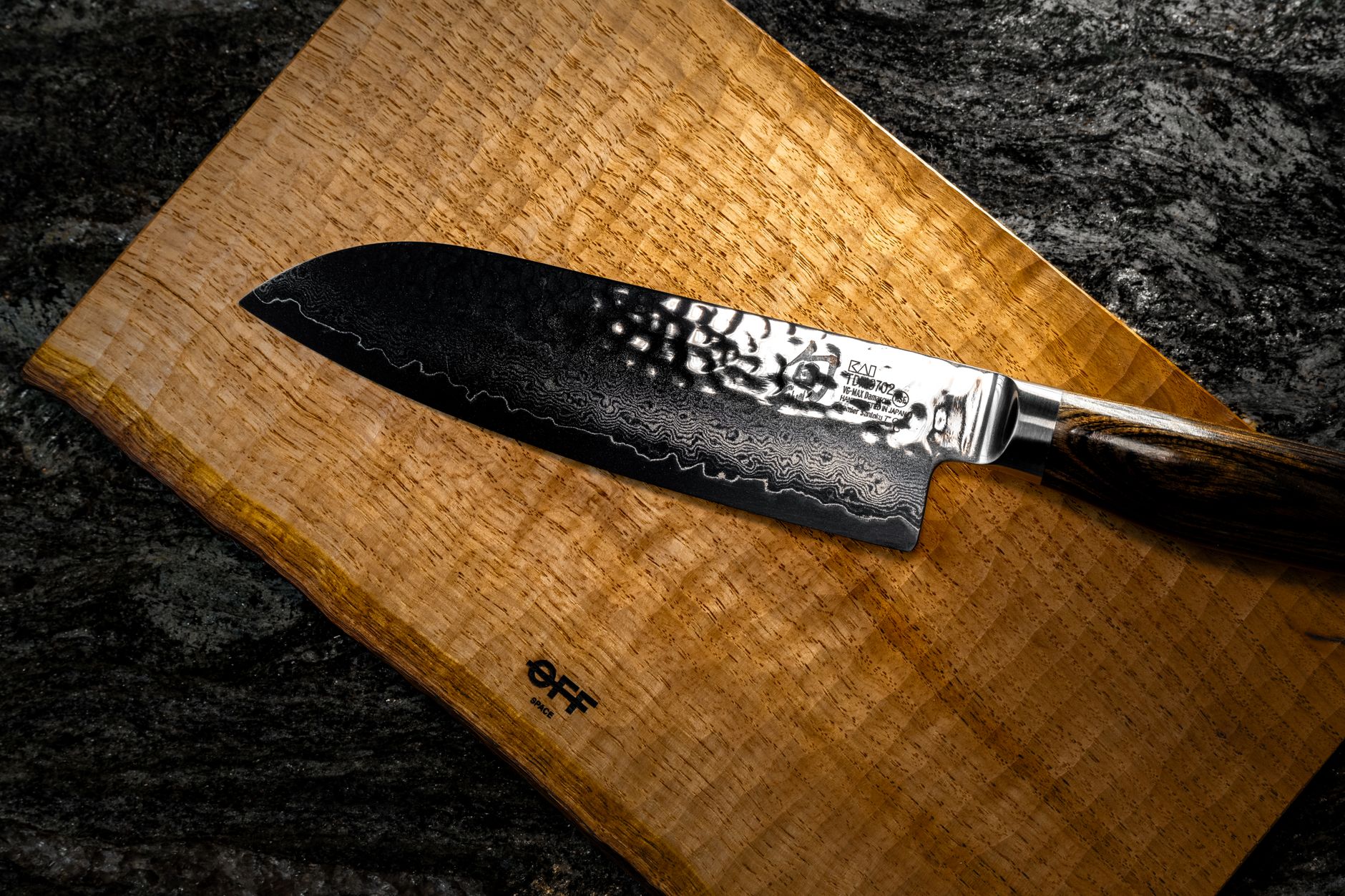

If you want one all-purpose Western knife with a curved belly for rocking chops, choose a chef knife. If you prefer push cuts, thinner slices, a shorter blade, and a lighter feel, choose a santoku. For most home cooks, a 5- or 7-inch santoku is the easier daily prep knife; a chef knife wins for heavy meat prep and rocking technique.
Products Mentioned in This Guide
As an Amazon Associate, TheGearPool may earn from qualifying purchases.
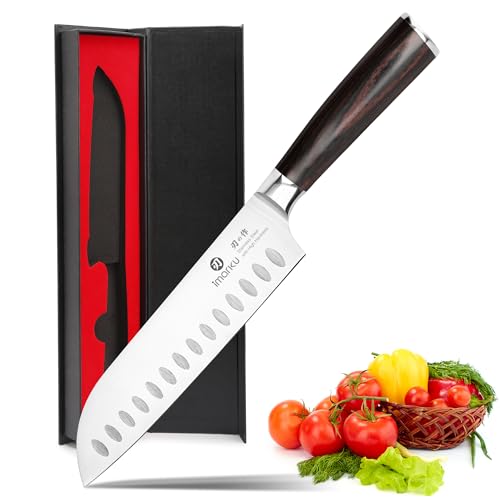


Short Verdict
Santoku knives are compact Japanese-style blades built for push cuts, straight chopping, and precise vegetable work. Chef knives are Western-style all-rounders built for rocking chops, pointed-tip work, and larger batches. If you only buy one and you already use a rocking motion, go with a chef knife. If you want easier daily veg prep and a shorter blade, go with a santoku.
- Blade shape: Santoku has a flatter edge and rounded sheep’s-foot tip; chef knife has a curved belly and pointed tip.
- Length: The exact santoku models here are 5 or 7 inches; chef knives are usually longer.
- Cutting style: Santoku suits push cuts and straight chops; chef knife suits rocking chops.
- Best fit: Santoku fits smaller kitchens and lighter daily prep; chef knife fits heavy prep and larger batches.
Table of Contents
Santoku vs Chef Knife: Side-by-Side
| Feature | Santoku | Chef Knife |
|---|---|---|
| Blade profile | Flatter edge, rounded or sheep’s-foot tip | Curved belly, pointed tip |
| Typical cutting style | Push cuts, draw cuts, straight up-and-down chopping | Rocking chops, tip-first piercing |
| Length in this article | 5 or 7 inches | Usually longer than the 5- and 7-inch santoku models here |
| Feel | Often shorter and lighter | Often heavier with more forward blade presence |
| Great for | Vegetables, fruit, fish, boneless proteins, precise slicing | Larger batches, heavy meat prep, rocking through herbs and dense produce |
Affiliate disclosure: TheGearPool is reader-supported. If you buy through links in this article, we may earn a commission at no extra cost to you.
Exact Santoku Models Compared
The supplied product set contains five santoku-style knives, so the exact-model comparison below focuses on santoku options. Use the chef knife column in the table above for the Western-style category comparison.
| Exact Model | Blade Length | Manufacturer-Highlighted Features | Edge / Handle Notes |
|---|---|---|---|
| imarku Santoku Knife 7 Inch with Sharp Japanese High Carbon Stainless Steel | 7 inches | Japanese high carbon stainless steel; hollow edge; Pakkawood handle; gift box | Hand-polished 15–18° per side; 2.5mm blade thickness |
| OXO Good Grips 5 in Santoku Knife with Locking Sheath | 5 inches | Straight edge; rounded non-pointed tip; locking sheath; soft non-slip grip | Stainless steel blade; soft handle |
| HOSHANHO 7 Inch Japanese Chef Knife, Ultra Sharp Kitchen Santoku Knives | 7 inches | Triple-layer 10Cr15CoMoV steel; 62HRC; double-side groove; African Pakkawood; gift box | Hand-sharpened 15° edge |
| Santoku Knife, 7 Inch Kitchen Knife, Ultra Sharp Chef Knife, Chef’s Knife | 7 inches | High-carbon 3CR13MOV steel; hollow edge; ABS handle; lifetime warranty | Hand-polished 15–18° per side; 0.08 inch thickness |
| imarku Santoku Knife 5 Inch, Ultra Sharp Chef Knife with Pakkawood Handle | 5 inches | Anti-stick surface; FSC-Certified Pakkawood handle; gift box | Hand-polished 15–18° edge; 2.3mm blade |
Tradeoffs by Dimension
Blade Shape and Tip
A santoku’s flatter edge and rounded tip reduce accidental piercing and work well for push cuts. A chef knife’s curved belly and pointed tip are better for rocking through herbs, dense vegetables, and meat.
Blade Length
The santoku models in this article are 5 or 7 inches. A 5-inch blade gives more control in small spaces; a 7-inch blade adds reach for larger produce or bigger batches. Chef knives are usually longer, which can speed up large prep tasks but may feel unwieldy in a small kitchen.
Edge Angle and Sharpness
Several supplied santoku models list a 15–18° edge per side. The HOSHANHO model lists a hand-sharpened 15° angle and 62HRC hardness. Thin Japanese-style edges can slice cleanly, but they may need more careful use and maintenance than a thicker Western blade.
Handle and Balance
The imarku and HOSHANHO models use Pakkawood handles; OXO uses a soft non-slip grip; QEGNOBOK uses an ABS handle. Santoku knives are often lighter and shorter than chef knives, which can reduce wrist strain during everyday prep.
Food Release
Several models here list hollow-edge or anti-stick designs: the imarku 7-inch, QEGNOBOK 7-inch, HOSHANHO 7-inch, and imarku 5-inch. These grooves or surface treatments can reduce food sticking when slicing starchy or moist items. The OXO 5-inch uses a straight edge.
Cutting Motion
Use a santoku for push cuts, draw cuts, and straight up-and-down chopping. Use a chef knife when you want a rocking pivot on the curved belly. If you naturally rock the tip on the board, a chef knife may feel more natural.
Maintenance and Care
Manufacturer care guidance is not supplied for every model, so follow the maker’s instructions. In general, hand wash kitchen knives, dry them immediately, and use a honing rod or whetstone appropriate for the blade. The OXO model includes a locking sheath for storage and transport.
Who Should Choose Each
Choose a Santoku If…
- You prep a lot of vegetables, fruit, fish, and boneless meat.
- You prefer push cuts or quick up-and-down chopping.
- You want a shorter, lighter blade for a smaller kitchen or smaller hands.
- You like Japanese-style edge geometry and hollow-edge food release.
Choose a Chef Knife If…
- You do heavy meat prep or need a pointed tip.
- You prefer rocking chops and a longer blade.
- You want one Western-style all-rounder for large batches.
Exact Santoku Model Choices
- 7-inch daily prep pick: imarku Santoku Knife 7 Inch with Sharp Japanese High Carbon Stainless Steel — hollow edge, Pakkawood handle, and a 15–18° edge claim.
- 5-inch storage-sheath pick: OXO Good Grips 5 in Santoku Knife with Locking Sheath — straight edge, rounded tip, and protective sheath.
- High-hardness 7-inch pick: HOSHANHO 7 Inch Japanese Chef Knife, Ultra Sharp Kitchen Santoku Knives — manufacturer-listed 62HRC and a 15° edge claim.
- Hollow-edge 7-inch pick: Santoku Knife, 7 Inch Kitchen Knife, Ultra Sharp Chef Knife, Chef’s Knife — QEGNOBOK model with 15–18° edge claim and ABS handle.
- Compact 5-inch control pick: imarku Santoku Knife 5 Inch, Ultra Sharp Chef Knife with Pakkawood Handle — anti-stick surface and a 2.3mm blade claim.
FAQ
Can a santoku knife replace a chef knife?
For many home cooks, yes. A 5-inch or 7-inch santoku can handle daily chopping, slicing, dicing, and mincing. A chef knife may still be better for heavy meat work or when you prefer longer rocking cuts.
Is a santoku better than a chef knife for vegetables?
Many cooks find a santoku easier for vegetables because of its flatter edge, shorter blade, and lighter feel. The hollow-edge models in this article are marketed to reduce food sticking during slicing and dicing.
What is the main difference in blade shape?
A santoku usually has a flatter edge and a rounded or sheep’s-foot tip. A chef knife usually has a curved belly and a pointed tip. That changes how the knife contacts the board: push cuts versus rocking cuts.
Should I choose a 5-inch or 7-inch santoku?
Choose 5 inches if you want maximum control, have a smaller cutting board, or prefer a lighter blade. Choose 7 inches if you want more reach for larger produce or larger batches. The supplied models include both sizes.
Do santoku knives need special sharpening?
No. The method depends on the blade material and edge angle, not the name. Several models here list a 15–18° edge per side. Follow the manufacturer’s sharpening guidance and avoid electric sharpeners unless the maker says they are safe.
Why do some santoku knives have grooves or hollow edges?
Grooves or hollow-edge scallops create an air gap between the blade and food, which can reduce sticking when slicing or dicing starchy or moist foods. The imarku, HOSHANHO, QEGNOBOK, and imarku 5-inch models in this article mention this design.