
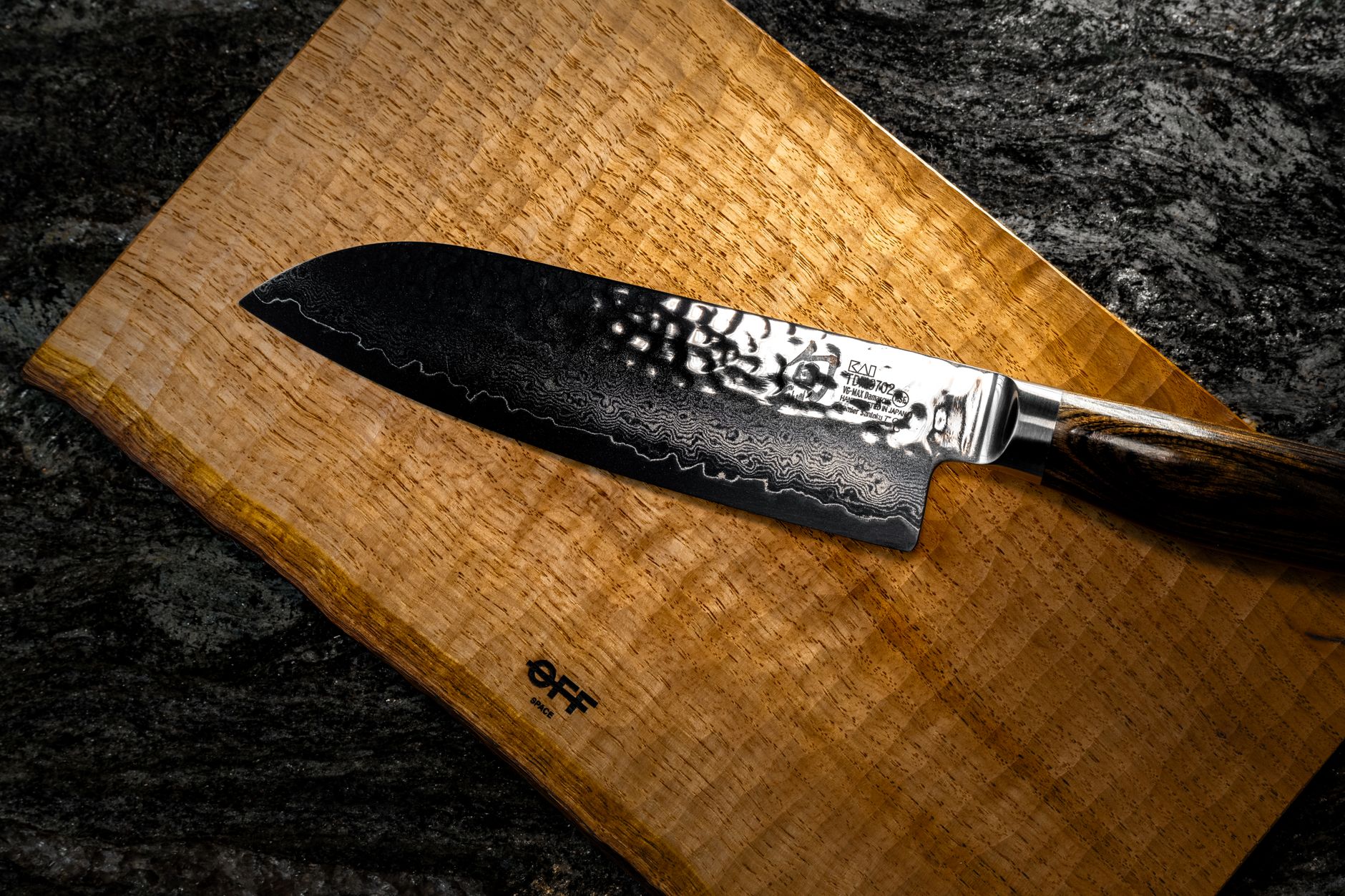

Short verdict: A chef’s knife is usually a longer Western blade with a curved belly for rocking cuts; a santoku is a shorter Japanese-style blade with a flatter edge, rounded tip, and often a hollow or anti-stick blade for push cuts, slicing, and dicing. For most home cooks, a 7-inch santoku can replace a chef’s knife for everyday prep. Choose a 5-inch santoku if you want more compact control. This guide compares the difference and five exact santoku models in TheGearPool’s product database.
Affiliate disclosure: As an Amazon Associate, TheGearPool earns from qualifying purchases. This article includes Amazon affiliate links.
Products Mentioned in This Guide
As an Amazon Associate, TheGearPool may earn from qualifying purchases.


Key takeaways
- Blade shape is the biggest difference: chef’s knives favor rocking cuts; santoku knives favor push cuts and tap-chopping.
- Santoku blades are often shorter: the exact models in this guide are 5-inch or 7-inch blades, which can feel more controllable than a larger Western chef’s knife.
- Edge geometry varies: supplied imarku, HOSHANHO, and QEGNOBOK models document 15-degree or 15–18-degree edges, which support thinner, precise cuts.
- Food release matters: several supplied models use hollow-edge, grooved, or anti-stick designs to reduce sticking.
- For many home cooks, a 7-inch santoku can replace a chef’s knife; a 5-inch model is better for smaller prep spaces and detailed work.
Exact models compared
TheGearPool’s product database includes these five exact santoku-style models. Manufacturer-documented details are summarized below; no prices, ratings, or hands-on test claims are included because they were not supplied in the product records.
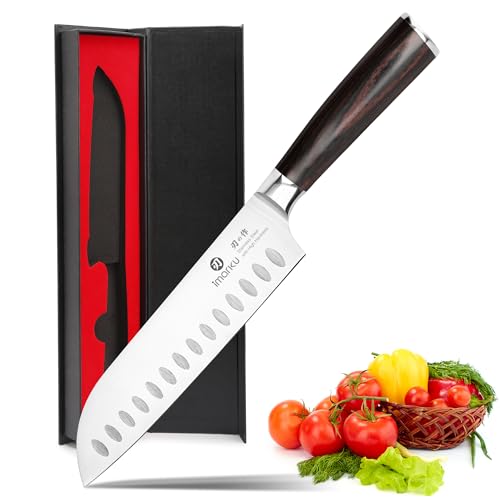
- imarku Santoku Knife 7 Inch with Sharp Japanese High Carbon Stainless Steel — 7-inch scalloped hollow-edge blade, Japanese high-carbon stainless steel, Pakkawood handle, and documented 15–18° edge per side.
- OXO Good Grips 5 in Santoku Knife with Locking Sheath — 5-inch stainless steel straight edge, rounded non-pointed tip, soft non-slip handle, and locking sheath.
- HOSHANHO 7 Inch Japanese Chef Knife, Ultra Sharp Kitchen Santoku Knives — 7-inch triple-layer laminated steel blade, documented 15° angle, African Pakkawood handle, and double-side grooves.
- Santoku Knife, 7 Inch Kitchen Knife, Ultra Sharp Chef Knife, Chef’s Knife (QEGNOBOK) — 7-inch high-carbon German steel blade, hollow edge, ABS handle, and documented 15–18° edge.
- imarku Santoku Knife 5 Inch, Ultra Sharp Chef Knife with Pakkawood Handle — 5-inch anti-stick blade, 2.3mm thickness, FSC-certified Pakkawood handle, and 15–18° edge.
Side-by-side table: chef knife vs santoku
This general comparison focuses on functional differences. The exact model table below follows the same dimensions.
| Dimension | Chef’s knife | Santoku |
|---|---|---|
| Blade shape | Longer, curved belly | Shorter, flatter edge with rounded tip |
| Typical length | Often 8–10 inches | Often 5–7 inches |
| Cutting style | Rocking, slicing, heavy chopping | Push cuts, tap-chopping, precise slicing |
| Edge profile | Varies by maker | Supplied models document 15° or 15–18° per side on several options |
| Food release | Usually smooth blade | Common scalloped or grooved designs in supplied models |
Exact models side-by-side
| Model | Blade length | Documented edge/steel | Handle | Notable feature |
|---|---|---|---|---|
| imarku Santoku Knife 7 Inch with Sharp Japanese High Carbon Stainless Steel | 7 in | Japanese high-carbon stainless steel; 15–18° per side; 2.5mm thick | Pakkawood | Scalloped hollow edge |
| OXO Good Grips 5 in Santoku Knife with Locking Sheath | 5 in | Stainless steel straight edge | Soft non-slip grip | Locking sheath; rounded non-pointed tip |
| HOSHANHO 7 Inch Japanese Chef Knife, Ultra Sharp Kitchen Santoku Knives | 7 in | Triple-layer laminated 10Cr15CoMoV; documented 15° angle; manufacturer 62HRC hardness claim | African Pakkawood | Double-side groove; frosted design |
| Santoku Knife, 7 Inch Kitchen Knife, Ultra Sharp Chef Knife, Chef’s Knife (QEGNOBOK) | 7 in | High-carbon German steel 3CR13MOV; 15–18° per side; 0.08 in thick | ABS | Hollow edge; documented lifetime warranty claim |
| imarku Santoku Knife 5 Inch, Ultra Sharp Chef Knife with Pakkawood Handle | 5 in | 15–18° edge; 2.3mm thick | FSC-certified Pakkawood | Anti-stick blade surface |
Dimension-by-dimension tradeoffs
Blade length: 5-inch vs 7-inch
A 5-inch santoku—such as the imarku Santoku Knife 5 Inch, Ultra Sharp Chef Knife with Pakkawood Handle or OXO Good Grips 5 in Santoku Knife with Locking Sheath—is easier to maneuver and better for detailed cutting, smaller cutting boards, and cooks with smaller hands. A 7-inch santoku—such as the imarku Santoku Knife 7 Inch with Sharp Japanese High Carbon Stainless Steel, HOSHANHO 7 Inch Japanese Chef Knife, Ultra Sharp Kitchen Santoku Knives, or Santoku Knife, 7 Inch Kitchen Knife, Ultra Sharp Chef Knife, Chef’s Knife—gives more board clearance and a longer cutting surface for larger vegetables, meats, and multi-ingredient prep.
Blade shape and cutting motion
Chef’s knives use a pronounced belly so the blade rocks from tip to heel. Santoku knives have a flatter edge and rounded non-pointed tip, which suits push cuts, tap-chopping, and straight-down dicing. If you rock the blade heavily, a classic chef’s knife may feel more natural. If you push-cut or chop with less rocking, a santoku often feels faster.
Edge geometry and steel
The supplied imarku, HOSHANHO, and QEGNOBOK models document thin-edge geometry. The imarku 7-inch, imarku 5-inch, and QEGNOBOK 7-inch list 15–18° per side; HOSHANHO documents a 15° blade angle. These thinner edges are designed for clean slicing, but they require careful use and hand washing. The QEGNOBOK uses high-carbon German steel; HOSHANHO uses Japanese 10Cr15CoMoV laminated steel; imarku 7-inch uses Japanese high-carbon stainless steel.
Food release and blade finish
The imarku 7-inch and QEGNOBOK 7-inch have scalloped hollow-edge blades. HOSHANHO has double-side grooves. The imarku 5-inch uses an anti-stick blade surface. These designs are documented to help reduce food sticking. OXO uses a stainless steel straight edge with a rounded non-pointed tip rather than a hollow edge.
Handle and grip
The imarku 7-inch and HOSHANHO 7-inch use Pakkawood handles; imarku 5-inch uses FSC-certified Pakkawood. QEGNOBOK uses an ABS handle. OXO uses a soft, non-slip grip. If you prioritize a wood-resin feel, choose a Pakkawood model. If you want a more cushioned grip and a protective sheath, the OXO is the only supplied model with a locking sheath.
Maintenance and storage
None of the supplied product records state that these knives are dishwasher safe. Hand washing and drying immediately is the safe default to protect thin edges and handle materials. The OXO includes a locking sheath, which helps protect the blade during storage or transport.
Who should choose each
Choose a Western chef’s knife if: you use a strong rocking motion, want a longer blade for large cuts, or prefer a traditional Western workhorse. This guide does not include a supplied chef’s knife model, so treat the chef’s knife as the baseline style.
Choose a santoku if: you like push cuts, tap-chopping, controlled dicing, or a shorter blade. The supplied 7-inch models are the closest all-purpose stand-ins for a chef’s knife; the 5-inch models are best for compact kitchens, small hands, and detail work.
- imarku Santoku Knife 7 Inch with Sharp Japanese High Carbon Stainless Steel — all-purpose 7-inch prep with hollow-edge food release.
- HOSHANHO 7 Inch Japanese Chef Knife, Ultra Sharp Kitchen Santoku Knives — harder, thinner-edge Japanese steel for precise slicing, if you maintain a high-hardness blade.
- Santoku Knife, 7 Inch Kitchen Knife, Ultra Sharp Chef Knife, Chef’s Knife (QEGNOBOK) — high-carbon German steel 7-inch with hollow edge and ABS handle.
- imarku Santoku Knife 5 Inch, Ultra Sharp Chef Knife with Pakkawood Handle — smaller blade for controlled, detailed cuts and a Pakkawood handle.
- OXO Good Grips 5 in Santoku Knife with Locking Sheath — compact, non-slip grip and locking sheath for simple storage and transport.
FAQ
Can a santoku replace a chef’s knife?
For many home cooks, yes. A 7-inch santoku covers slicing, dicing, mincing, and chopping vegetables, fruits, meats, and bread. If you do heavy rocking cuts or break down large cuts, a longer chef’s knife may still be useful.
Which is better: 5-inch or 7-inch santoku?
It depends on control vs capacity. The 5-inch models in this guide—OXO and imarku—are easier to maneuver for detailed work. The 7-inch models—imarku, HOSHANHO, and QEGNOBOK—offer more length for larger prep.
What edge angle do these santoku knives use?
Several supplied models document 15–18° per side: imarku 7-inch, imarku 5-inch, and QEGNOBOK 7-inch. HOSHANHO documents a 15° blade angle. These are manufacturer-provided specs.
Are these santoku knives dishwasher safe?
The product records do not state dishwasher safety. To protect the edge and handle, hand wash and dry immediately.
What is the hollow edge on a santoku for?
On the supplied imarku 7-inch and QEGNOBOK 7-inch models, the scalloped hollow edge creates gaps between the blade and food to reduce sticking while slicing, dicing, and mincing. HOSHANHO uses double-side grooves for a similar function.